Antiquarenbeurs Mechelen
Exhibitor
Mille Septante BooksRue Georges Moreau 118
1070 Anderlecht
Belgium
Contact
Stefan HuberPhone
+32 498 28 86 98 +32 498 28 86 98Website
www.milleseptantebooks.com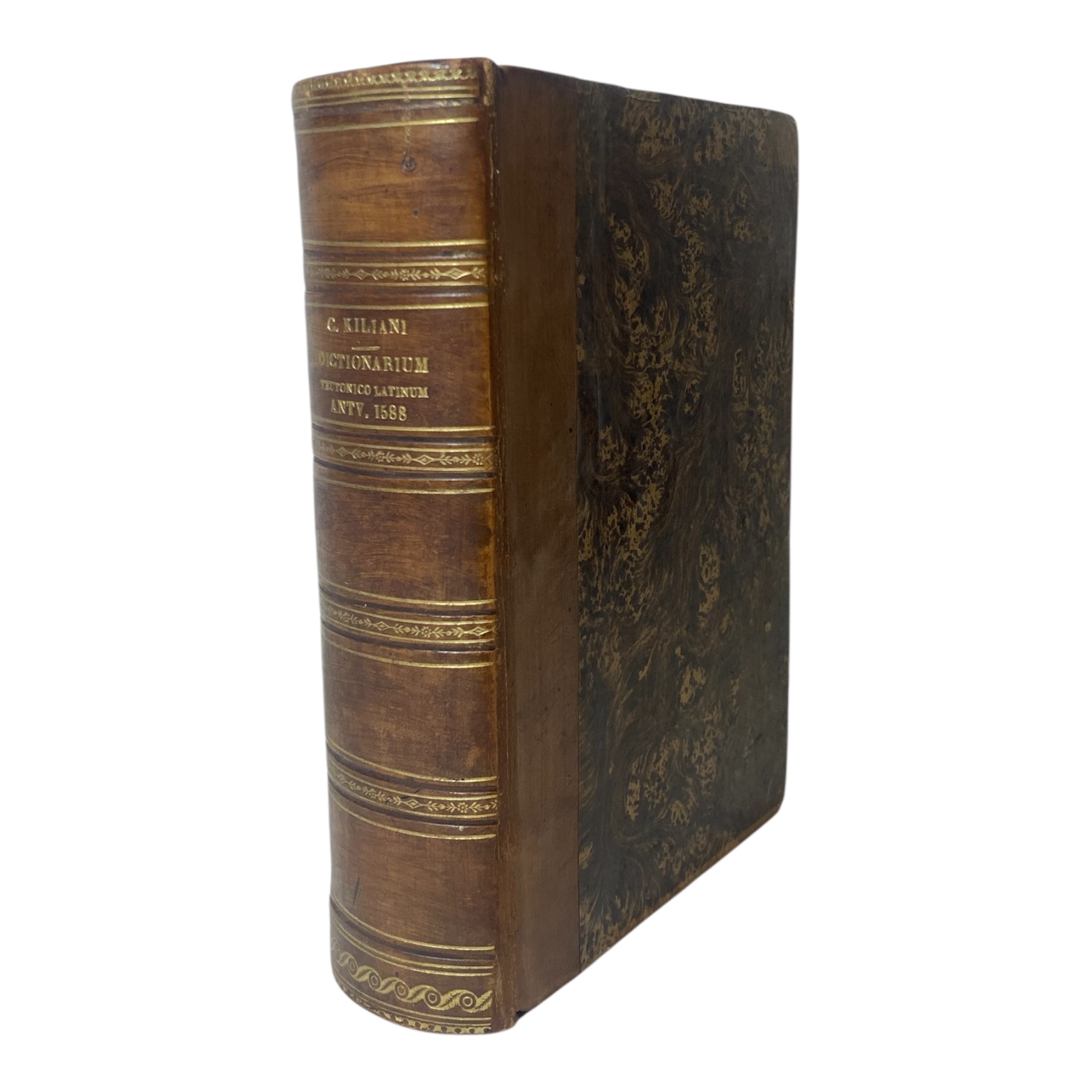
Dictionarium Teutonico-Latinum
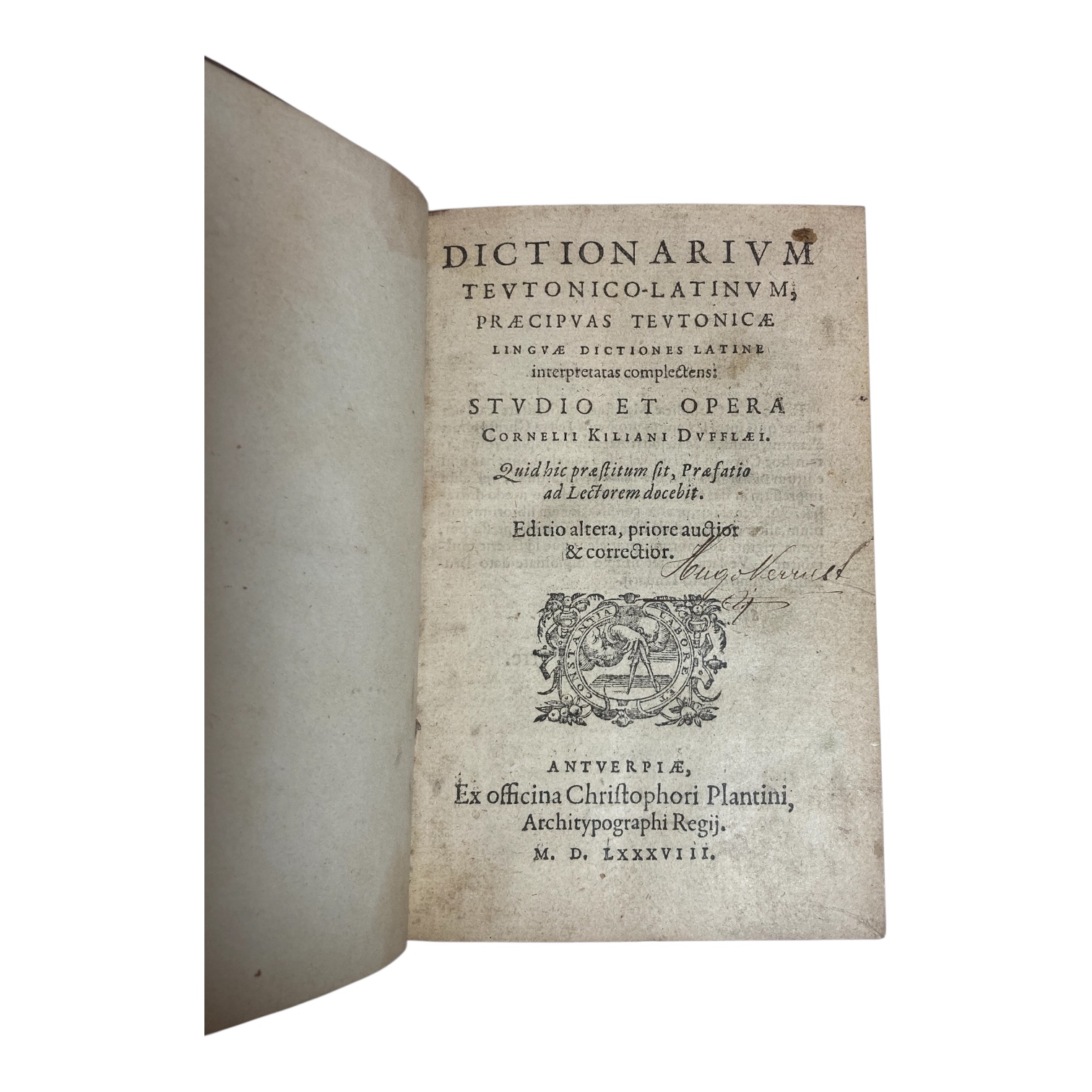
Antwerp, Christophe Plantin, 1588. Small 8vo, later 19th century half leather binding, gilt titles and decorative motifs on the spine, (1)-765-(3) pp.; excellent copy with slight wear to the corners, handwritten ex-libris on the title-page next to the publisher's woodcut device
A rare and beautiful copy of the greatly expanded and enlarged second edition of Kiliaan's Dictionarium of 1574 in which he further developed his etymological language comparisons. His scholarly interest in giving as complete a description of Dutch as possible, manifests in this second edition in his use of not only dictionaries as a source, but also of published works of varying genres. Another innovative feature is the inclusion of regional indications for a number of entries?for example, fland., holl., fris., and sic.?which Kiliaan explained in his introduction as follows: "Flandris, Hollandis, Frisiis, Sicambris (Gheldris nempe, Cliuiis & Iuliacis) ... visitatissimas.?. Cornelis Kiliaan (1528/1530?1607) worked for several years as a proofreader at the Officina Plantiniana before Plantin decided to publish a dictionary and invited Kiliaan to collaborate with him. From that moment on, dictionaries became Kiliaan?s life?s work, and he came to be regarded as the father of modern Dutch lexicography. Copy of Hugo Verriest with his ex-libris in handwriting on the title-page and a small handwritten note tipped in with details of the purchase by Verriest. The Flemish priest and writer Hugo Verriest (1840?1922) was a key intellectual force behind the Catholic flamingant student movement in the 19th century that opposed the dominance of French in education. From the 1890s onward, he emerged as a socially engaged Christian Democrat and emerged as a unique unifying figure, beloved by Catholics as well as socialists, liberals, and freethinkers. Rare and important copy with an extraordinary provenance that highlights the emancipation of the Dutch language in Flanders over centuries.
A rare and beautiful copy of the greatly expanded and enlarged second edition of Kiliaan's Dictionarium of 1574 in which he further developed his etymological language comparisons. His scholarly interest in giving as complete a description of Dutch as possible, manifests in this second edition in his use of not only dictionaries as a source, but also of published works of varying genres. Another innovative feature is the inclusion of regional indications for a number of entries?for example, fland., holl., fris., and sic.?which Kiliaan explained in his introduction as follows: "Flandris, Hollandis, Frisiis, Sicambris (Gheldris nempe, Cliuiis & Iuliacis) ... visitatissimas.?. Cornelis Kiliaan (1528/1530?1607) worked for several years as a proofreader at the Officina Plantiniana before Plantin decided to publish a dictionary and invited Kiliaan to collaborate with him. From that moment on, dictionaries became Kiliaan?s life?s work, and he came to be regarded as the father of modern Dutch lexicography. Copy of Hugo Verriest with his ex-libris in handwriting on the title-page and a small handwritten note tipped in with details of the purchase by Verriest. The Flemish priest and writer Hugo Verriest (1840?1922) was a key intellectual force behind the Catholic flamingant student movement in the 19th century that opposed the dominance of French in education. From the 1890s onward, he emerged as a socially engaged Christian Democrat and emerged as a unique unifying figure, beloved by Catholics as well as socialists, liberals, and freethinkers. Rare and important copy with an extraordinary provenance that highlights the emancipation of the Dutch language in Flanders over centuries.
€ 2.500
View exhibitor's highlights