
Antiquarenbeurs Mechelen
Exposant
Antiquariaat De SlegteWapper 5
2000 Antwerpen
Belgium
Phone
0032(0)32316627 0032(0)32316627Website
www.deslegte.com
Very early 'Blue Marble' vintage print dedicated and signed '6-6-73' by astronauts James Lovell and Stuart A. Roosa
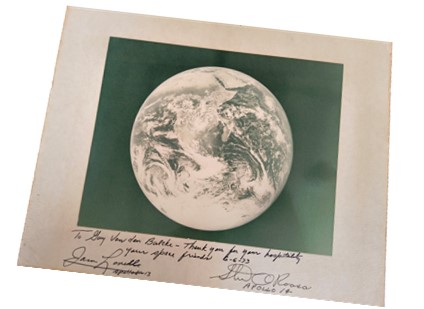
'Blue Marble'. View of the Earth as seen by the Apollo 17 crew. 1972.
Vintage C-print (chromogenic print) on fibre-based Kodak paper (25 x 20 cm), pasted on off-white board, framed.
* Taken from a distance of approximately 29,000 kilometers from earth on December 7th, this is the first photograph made by a human of the fully illuminated planet. Released by NASA on Christmas Eve 1972 this image quickly became known as the 'Blue Marble' and remains one of the most widely reproduced photographs in history. Our copy dedicated in writing 'To Guy Van den Bulcke 'Thank you for your hospitality. Your space friends 6-6-73', by notable Nasa astronauts James Lovell, Commander of Apollo 13 who also flew on Gemini 7, Gemini 12, and Apollo 8, and Stuart Roosa, Command Module Pilot on Apollo 14. Guy Van den Bulcke (1931 - 2024) was a Belgian painter and graphic artist. In the seventies he made a second start as an artist combining elements of pop art, hyperrealism and surrealism. Although this style was initially not successful in Belgium, he found recognition in the United States. A process in which art gallery 'La Colombe d'Or' in Houston (!) played a crucial role.
The image has a greenish tint background (probably due to longtime exposure to light) and is pasted on a wide, off-white board. Framed behind glass (but removable).
# Taken on the 7th of December 1972 by the Apollo 17 crew (most likely Harrison Schmitt or Ron Evans) during their journey toward the moon. This iconic image is one of the most recognized photographs of Earth. Captured with a 70mm Hasselblad camera, it shows the planet fully illuminated, with Africa, the Arabian Peninsula, and Antarctica clearly visible. This photograph is significant for its portrayal of Earth as a fragile, interconnected home, influencing environmental awareness and global unity.
The image has a greenish tint background (probably due to longtime exposure to light) and is pasted on a wide, off-white board. Framed behind glass (but removable).
# Taken on the 7th of December 1972 by the Apollo 17 crew (most likely Harrison Schmitt or Ron Evans) during their journey toward the moon. This iconic image is one of the most recognized photographs of Earth. Captured with a 70mm Hasselblad camera, it shows the planet fully illuminated, with Africa, the Arabian Peninsula, and Antarctica clearly visible. This photograph is significant for its portrayal of Earth as a fragile, interconnected home, influencing environmental awareness and global unity.
€ 3.500
View exhibitor's highlights